Newsletter October 2026
Latest news, events and opportunities.
Find out more


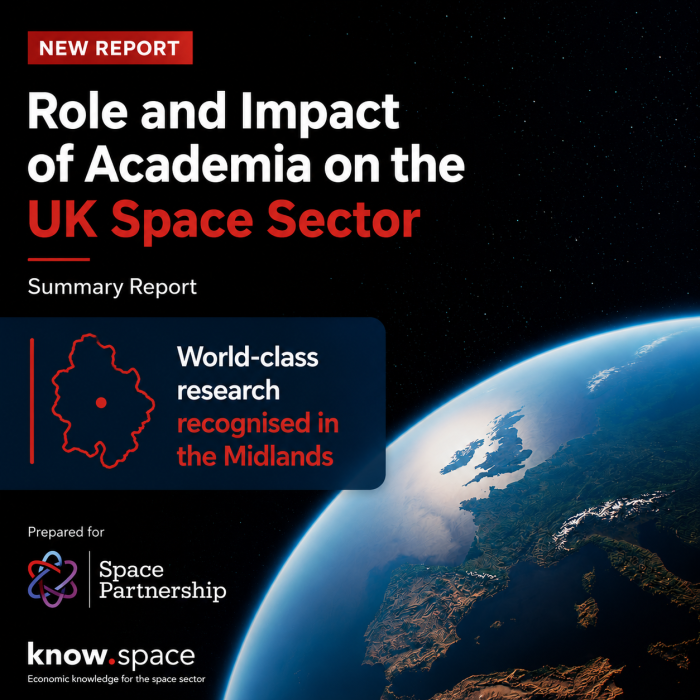
A report produced by know.space for Space Partnership, which details the role and impact of academia on the UK Space Sector, has now been published.
The Midlands emerges from the report as one of the UK’s most significant space research regions, combining the strengths of the East and West Midlands across all major areas of space activity. Together, the region hosts almost 600 space researchers and research organisations spanning the full breadth of the UK’s space capability landscape, from space science and Earth observation to advanced technologies, policy and sustainability. The University of Leicester is identified as a major contributor to the UK’s space research base, helping to make the East Midlands a disproportionately strong research region relative to its wider space industry footprint.
The report highlights the Midlands’ international leadership in major space missions and scientific research. Midlands institutions play key roles in flagship ESA and international programmes including Gaia, JUICE, Solar Orbiter, BIOMASS, MicroCarb and the future LISA mission. The region also demonstrates a strong track record in translating research into innovation, with examples such as Leicester’s Perpetual Atomics spin-out and Birmingham’s globally recognised work on space debris modelling and space sustainability.
Perhaps most importantly, the Midlands is shown to be contributing directly to national and international priorities. Research from Birmingham and Leicester supports UK critical national infrastructure through space weather forecasting, resilience and security applications, while Birmingham’s debris-environment modelling informs international regulation and sustainability discussions through the Inter-Agency Space Debris Coordination Committee and wider global forums. Collectively, the report presents the Midlands as a region with internationally recognised expertise, strong scientific influence, growing commercial impact and an increasingly important role in shaping the future of the global space sector.
You can read the full report here.